A second chance at life: Ian meets the NEAS crews who helped save him
26th November 2026
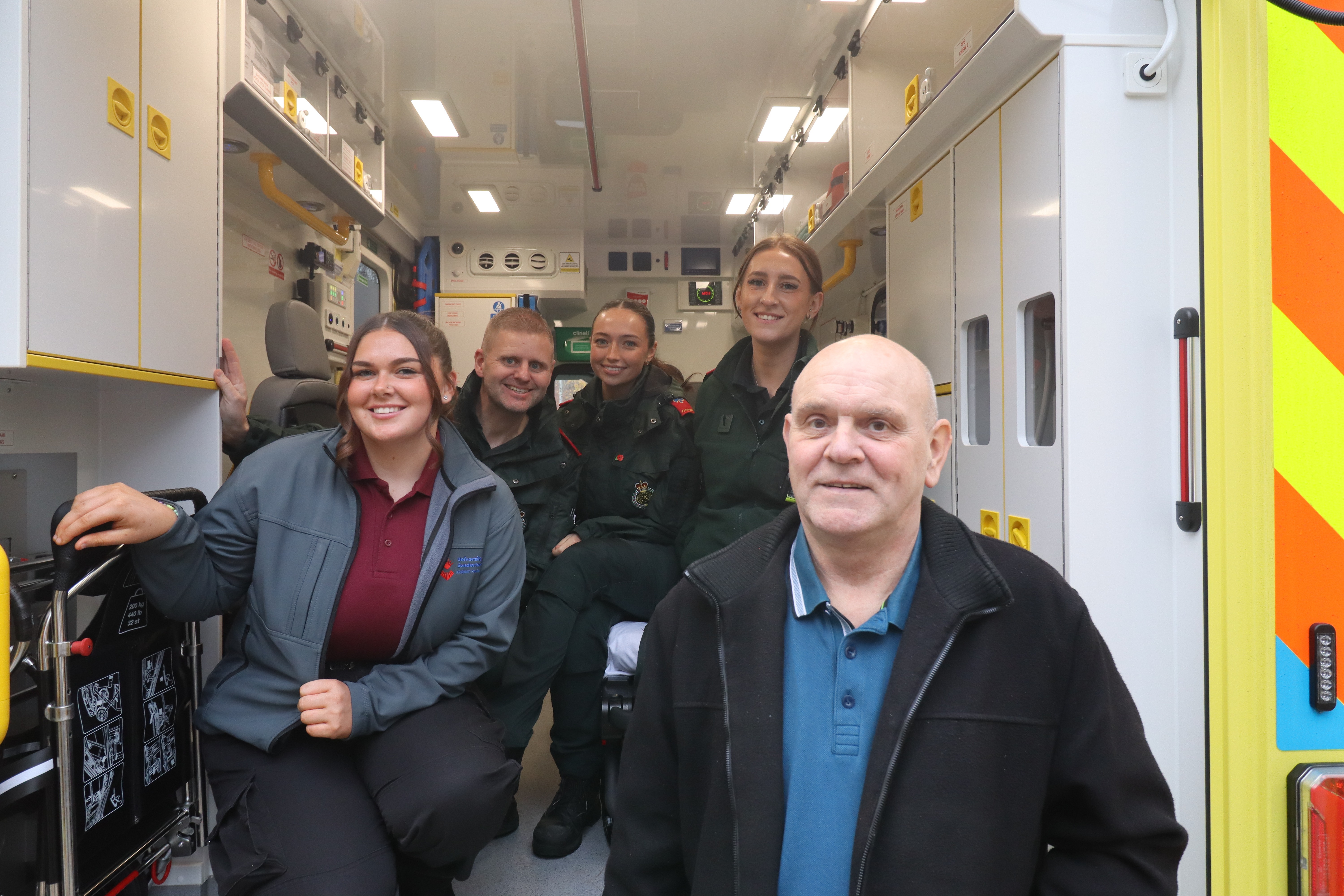
A man who went into cardiac arrest twice at home has been reunited with the ambulance crew who helped save his life.
Ian Gray, 63, from South Shields, had been suffering from heartburn and dizzy spells in the weeks leading up to his cardiac arrest, which was brought on by a heart attack on 16 July 2026.
Ian said: “Words cannot express how truly thankful and grateful we all are as a family for the support we were given. I can’t thank them enough for saving my life, it’s something I will never forget.”
When Ian went into cardiac arrest, those around him acted quickly. His wife, Sarah, and neighbour Emily stayed by his side, while Emily, who works as a nurse, performed CPR until ambulance crews arrived.
Emily’s ten-year-old son, Oscar, made the initial call to 999, helping guide the crews to Ian.
Emergency medical call handler Hannah Dickson took the initial 999 call and remembered: “Oscar was extraordinary. In what must have been a frightening and overwhelming situation, he showed remarkable courage and quick thinking. Alongside the support of his family, his actions helped save Ian’s life.”
Paramedic Neive Adey, her crewmate and Kirsten Connolly, a student paramedic arrived at the scene first. Neive said: “As we arrived, Oscar waved down the ambulance and directed us to the correct house. It was a very brave thing to do and meant we could reach Ian without delay. He was so calm and showed just how important it is for children to know how to call 999 and what important details would be needed to help us like street names and house numbers.”
Neive continued: “I feel incredibly honoured to have been involved in Ian’s resuscitation. It is rare in frontline practice to find out what happens to a patient after we have treated them, so to hear that Ian had made a full recovery made me incredibly proud to be a paramedic.”
Paramedic Philip Martin, who arrived soon after Neive, noted:
“The fact that bystander CPR had already been started before our arrival was incredibly important. It meant that Ian was receiving early vital intervention, helping to improving his chances of survival.
“This highlights the importance of the chain of survival. Early recognition of cardiac arrest, prompt contact with 999, immediate CPR, early defibrillation with advanced life support and post resuscitation care are all essential links in giving someone the best possible chance of survival. It also reinforces why teamwork, training and public awareness are so fundamental to what we do as ambulance clinicians.”
Specialist paramedic, Laura Hailes, arrived on scene shortly after, with the crews and clinical team leader (CTL) having successfully restart Ian’s heart.
Laura said: “The crews and CTL had done a brilliant job and provided excellent care before I arrived. Unfortunately, Ian’s heart stopped again, but thankfully we were able to restart it.
“I regularly attend patients in cardiac arrest, so I’m experienced in providing this kind of emergency. It was very much a team effort, and the specialist care I was able to provide built on the fantastic work already carried out by the crews and clinical team leader.”
After initial treatment from NEAS, Ian was taken to the Freeman Hospital where he underwent surgery to begin his road to recovery.
Reflecting on recent months, Ian said: “My daughter Charlotte recently got engaged and is having a baby. If I hadn’t survived, I would have never been able to watch my daughter become a mum for the first time, marry her partner Ryan and meet my new grandson.
“We have planned a big family gathering for Christmas to celebrate life and the family will all be together.
“Sarah said you were all angels and we will never be able to repay you all for the kindness, quick response and support you gave us all that day. I will be thanking you for the rest of my life.”