

An 18-year-old who had a cardiac arrest outside the grounds on the Tyne Wear Derby Day earlier this year has been reunited with some of the team who saved his life.
Mason Brown, of Durham, was one of more than 50,000 fans making their way to St James’ Park ahead of the Newcastle match against Sunderland on 22 March, when he collapsed outside the Shark Bar – less than 100 yards away from the stadium – an hour before kick-off.
Within just 23 minutes, the team of police officers, ambulance crews and doctors had saved his life.
Mason has now been able to meet some of those responsible to thank them in person.
He said: “I was with my mates Thomas, James, Joe, Callum and Oliver and remember telling them I didn’t feel well and leaning on a cone. The next thing I remember is waking up in hospital.”
A group of Northumbria Police officers covering the match saw Mason collapse and immediately began CPR as well as raising the alarm over the radio.
Marc Hardingham and Ryan Dunlop from Northumbria Police’s public order public safety medics team were around the corner when they heard the call over the radio and rushed to help.
Having received additional medical training, they were also able to insert an i-Gel airway, a soft plastic device that is inserted into a person's mouth during a cardiac arrest to help keep the airway open and make it easier to get oxygen into the lungs.
Sitting in match control on behalf of North East Ambulance Service (NEAS) that day was Adam Brown, emergency preparedness, resilience and response (EPRR) manager, who quickly passed the details on to fellow EPRR manager Marianne Walton, who was working as match commander and swiftly mobilised some of the medical team working the match.
Meanwhile Sam Beere, who was working the match on behalf of St John Ambulance, had been alerted to the incident by supporters and was making his way to Mason with a defibrillator, delivering the first shock to Mason’s heart.
Local consultants Dr Kris Lawson and Dr Joe Cosgrove were two of four NUFC crowd doctors on duty that day.
Dr Cosgrove, a consultant in anaesthesia and intensive care medicine, managed Mason’s airway whilst emergency department consultant Dr Lawson led the resuscitation efforts, working with crews from NEAS and St John Ambulance.
“I’ve been to countless cardiac arrests, in and out of hospital, but I don’t think I have ever managed one in such a busy environment,” said Dr Lawson. “The crowd density was huge as it was just before kick-off, and whilst I was ‘in the zone’ with Mason, it did cause some logistical challenges with getting an ambulance in and out.”
Managing those challenges was Donna Hay, deputy head of EPRR at NEAS.
Whilst the rest of the team worked together to save Mason, Donna and the police managed the scene around them with support from Marianne, who was watching via CCTV in the control room and providing updates. Together, they ensured the responding ambulance could reach Mason through extremely busy crowds and get back out again by the safest route.
The team continued CPR on the way to hospital and Mason’s heart restarted just outside the Royal Victoria Infirmary. He was taken straight into the resuscitation area and spent eight days in hospital before undergoing radio-ablation therapy at the Freeman Hospital, a procedure aimed at stopping faulty electrical signals in his heart and keeping his heartbeat regular.
He is now recovering well, is back at work and has renewed his season ticket, and wanted to meet the team responsible for saving him, along with some of his family, including his mam Sharon.
She said: “We had just got to the pub to watch the match when we got the call to say we needed to get to the RVI. To be honest it was like being in a dream, it was awful.
“We had assumed he had been beaten up but we discovered that he had an underlying heart condition that we never knew about but the operation he had, and the medication he’s been given since, should mean it’s not life-threatening for him and he can get on with his life.
“It’s incredible how fast everyone got there, we just can’t thank them enough as a family.”
NEAS paramedic Adam Eales was working as Medic 10, posted in the Gallowgate end of St James' Park.
“At the time you don't really think about anything, you just crack on and work,” he said. “Looking back now, it’s great to think how well we all worked together and made a positive contribution to Mason's outcome.”
Fellow NEAS paramedic Mike Roberts, who was working as Medic 9 crowd paramedic, added: “It was an amazing feeling to receive a thank you email in the following days, knowing that I had made a difference to a young lad’s life. I was really looking forward to shaking his hand as it is not very often we get to see the people we help – in fact Mason was the first patient I’ve seen again in 10 years.”
Commonly confused with heart attacks – which is usually caused by a blockage in the heart – a cardiac arrest is when the heart suddenly stops, which means blood stops being circulated to the vital organs. Chest compressions provided during CPR pump blood around the body to keep someone alive until the ambulance crew arrives.
Every minute without CPR and defibrillation reduces the chance of survival by around 10%.
Only one in every 10 people that have a cardiac arrest survive to go home from hospital.
“We all had a role to play and we all knew what that role was,” said Sam. “What I do is a voluntary role but takes a lot of training and commitment, so to be able to meet Mason again is really gratifying, it just reminds me that it’s all worth it.”
NEAS provides medical cover at sporting, music and community events all over the region, supporting more than 350 over the last year. Each event takes hours of planning to ensure the safety of attendees.
Marianne said: “It’s nice to see all the training and planning we do lead to a positive outcome like it has for Mason and his family, and it’s great to be reminded why we do this job.”
“I think we can all take a great deal of professional pride in how the multi-disciplinary team managed the situation,” added Dr Cosgrave. “It was one of the smoothest cardiac arrests I’ve ever done outside hospital.”
It only takes a few minutes to learn CPR. To find out more, visit https://
To learn the difference between a cardiac arrest and a heart attack, visit: https://www.bhf.org.uk/informationsupport/heart-matters-magazine/medical/heart-attack-and-cardiac-arrest
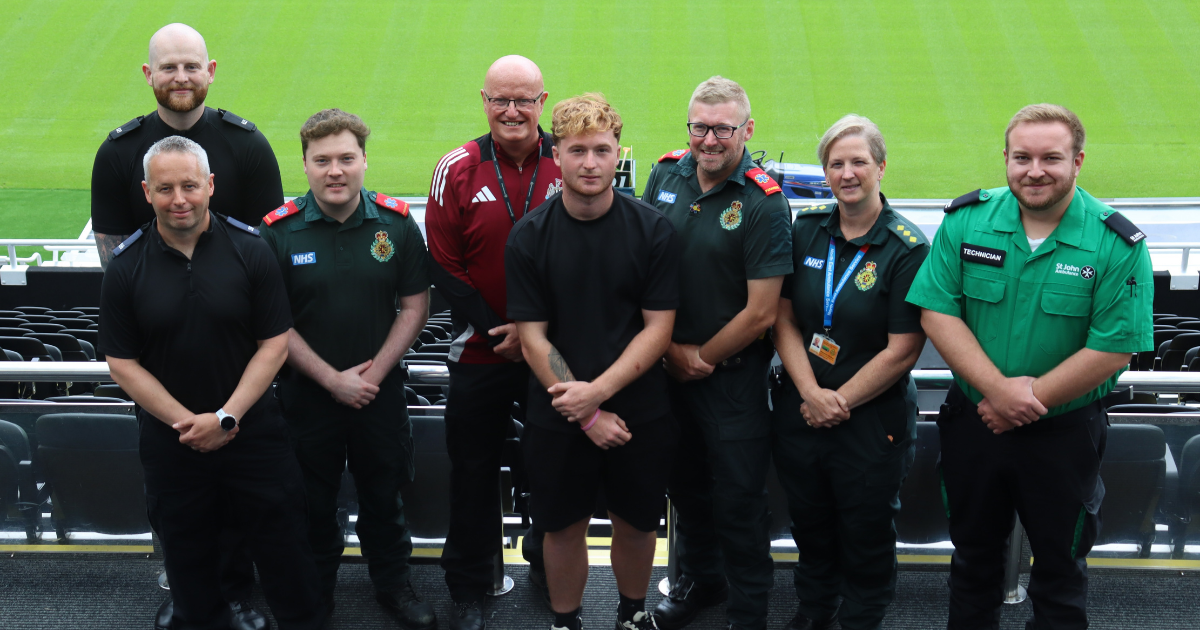
Mason Brown, 18, was reunited with some of the crew who saved his life