When an ambulance or other emergency vehicle is responding to an emergency, every second can matter. Road users can help emergency services reach people safely by knowing what to do when they see blue lights or hear sirens.
The most important thing is to stay calm, be aware of your surroundings and only move out of the way when it is safe to do so.
Whether you're driving, cycling, riding a motorcycle or using the road in another way, stay alert to emergency vehicles and give them space to pass when it is safe to do so.
Emergency service drivers are trained to assess the safest way through traffic. Sometimes the safest thing you can do is continue driving normally until there is a suitable opportunity for them to pass.
Rule 129 of the Highway Code
Rule 219 provides guidance on what to do when an emergency vehicle approaches. Always follow the rules of the road and avoid putting yourself or other road users at risk when making way.
The FAQs below explain what to do in some of the most common situations, including at traffic lights, junctions and on different types of roads.
If you see an ambulance or other emergency vehicle approaching with blue lights and sirens:
-
Stay calm and check around you before taking any action.
-
If there is a safe place to do so, move to the left and allow the emergency vehicle to pass.
-
Avoid braking suddenly or stopping somewhere that could block the road.
-
If there is nowhere safe to pull over, continue at a safe speed until you reach somewhere where the emergency vehicle can pass.
-
Do not mount the kerb or pavement or move into a cycle or bus lane.
-
Avoid stopping on bends, near the brow of a hill, at traffic islands or anywhere that could make it difficult for the emergency vehicle to get past.
-
Check before moving off again, as more than one emergency vehicle may be responding.
Stay calm and check around you before changing speed or direction.
The emergency vehicle may be approaching from another road or direction, so avoid braking suddenly or making an unexpected manoeuvre until you know where it is coming from.
Do not drive through a red light or cross the stop line to make way for an emergency vehicle.
If you are waiting at a red light, stay behind the stop line. Do not move through the red light unless you are directed to do so by a uniformed police officer.
Emergency service drivers will assess whether there is a safe way to pass. If there isn't, they may wait until the traffic lights change or there is enough space to continue safely.
If the lane is wide enough, you may be able to move slightly to the left to create space, but only if you can do so safely without crossing the stop line or entering a cycle lane.
You may sometimes notice an emergency vehicle turn off its siren while waiting behind traffic. Don't panic or assume the emergency is over. This can simply mean the driver is waiting for a safe opportunity to proceed.
If you are on a stretch of road with solid white lines, keep driving safely until you are clear of them and there is somewhere suitable for you to move left.
An emergency vehicle may turn off its siren while following you if there isn't a safe opportunity to overtake. Continue at a safe and legal speed rather than stopping somewhere unsafe.
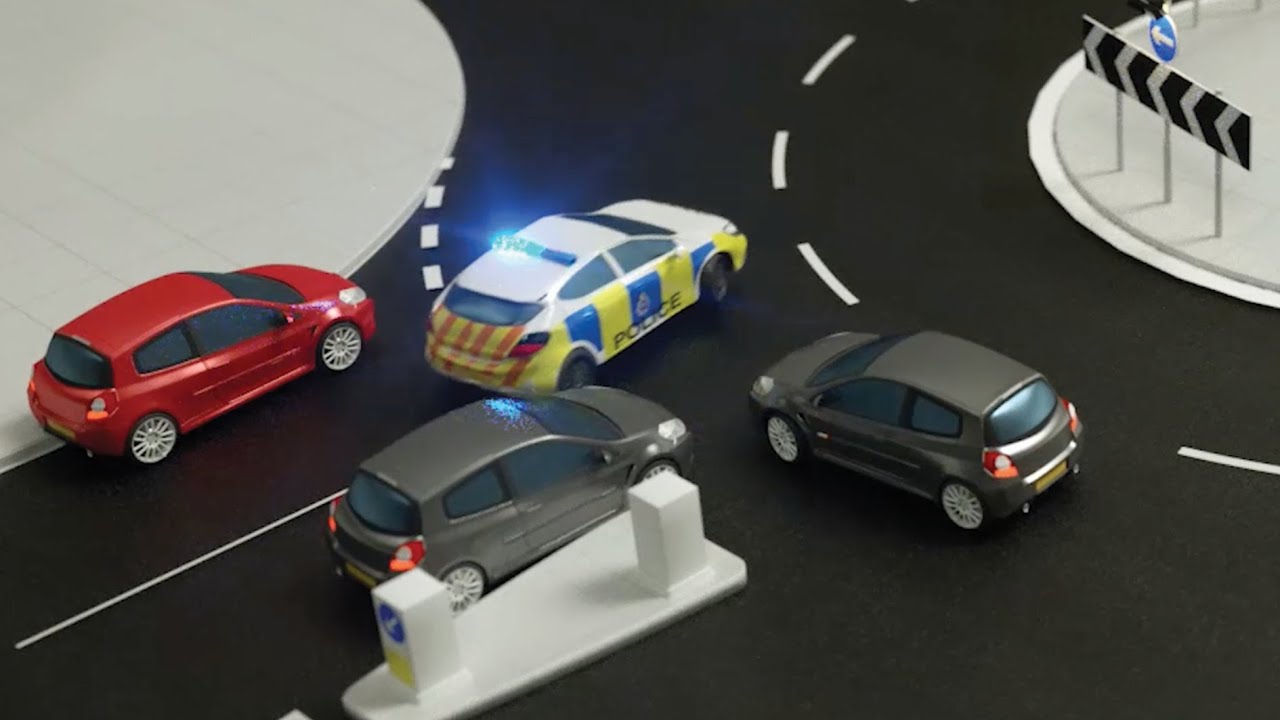
If you see an emergency vehicle as you approach a roundabout or junction, slow down and pay attention to where it is positioned.
If you are already at the junction, it may be safer to wait and allow the emergency vehicle to pass rather than making a sudden manoeuvre.
Remember that several emergency vehicles could be responding to the same incident, so check carefully before moving off again.
If traffic is moving, move to the left when it is safe to change lanes and allow the emergency vehicle to pass. Never stop in the right-hand lane.
If traffic is slow or stationary, pay attention to the position of the approaching emergency vehicle and be prepared to create space so it can pass.
Always follow overhead signs and never drive in a lane marked with a red X.
Everyone can help emergency vehicles make progress safely.
If you're walking or cycling, stay alert for blue lights and sirens, particularly when crossing roads or approaching junctions. Avoid stepping or riding into the path of an emergency vehicle, even if other traffic has stopped.
If you're cycling or riding a motorcycle, avoid making sudden movements and don't put yourself or others at risk trying to get out of the way. Move somewhere safe when you can and allow the emergency vehicle to pass.
Emergency service drivers will also take additional care around horses and riders and may turn off their sirens when approaching. If you're riding a horse, remain alert as there may be more than one emergency vehicle responding.
Check carefully before moving off or returning to your normal position on the road. There may be more emergency vehicles following behind.
Do not follow closely behind an emergency vehicle or use the space it has created to make your way through traffic.
Give ambulances space when they're parked
When our crews arrive at an emergency, their priority is reaching and treating the patient as quickly and safely as possible.
Please avoid blocking an ambulance in or parking too close to the rear of the vehicle. Crews may need space to use equipment, including the ambulance tail lift, or to safely move a patient into the vehicle.
Leaving plenty of room also helps our crews leave quickly when they need to take a patient to hospital or respond to another emergency.
Remember: stay calm, stay safe and follow the rules of the road
When you see blue lights or hear sirens:
-
Stay calm and check your surroundings.
-
Move left when it is safe to do so.
-
Don't put yourself or other road users at risk.
-
Don't drive through a red light.
-
Don't stop somewhere that could block an emergency vehicle.
-
Check for other emergency vehicles before moving off.
Emergency service drivers are trained to safely negotiate traffic while responding to emergencies. By staying calm and making safe, predictable decisions, you can help them reach people who need them.
Find out more
The Blue Light Aware resource provides helpful videos showing what to do in different situations when an emergency vehicle approaches, including at traffic lights, junctions, on motorways and around solid white lines.